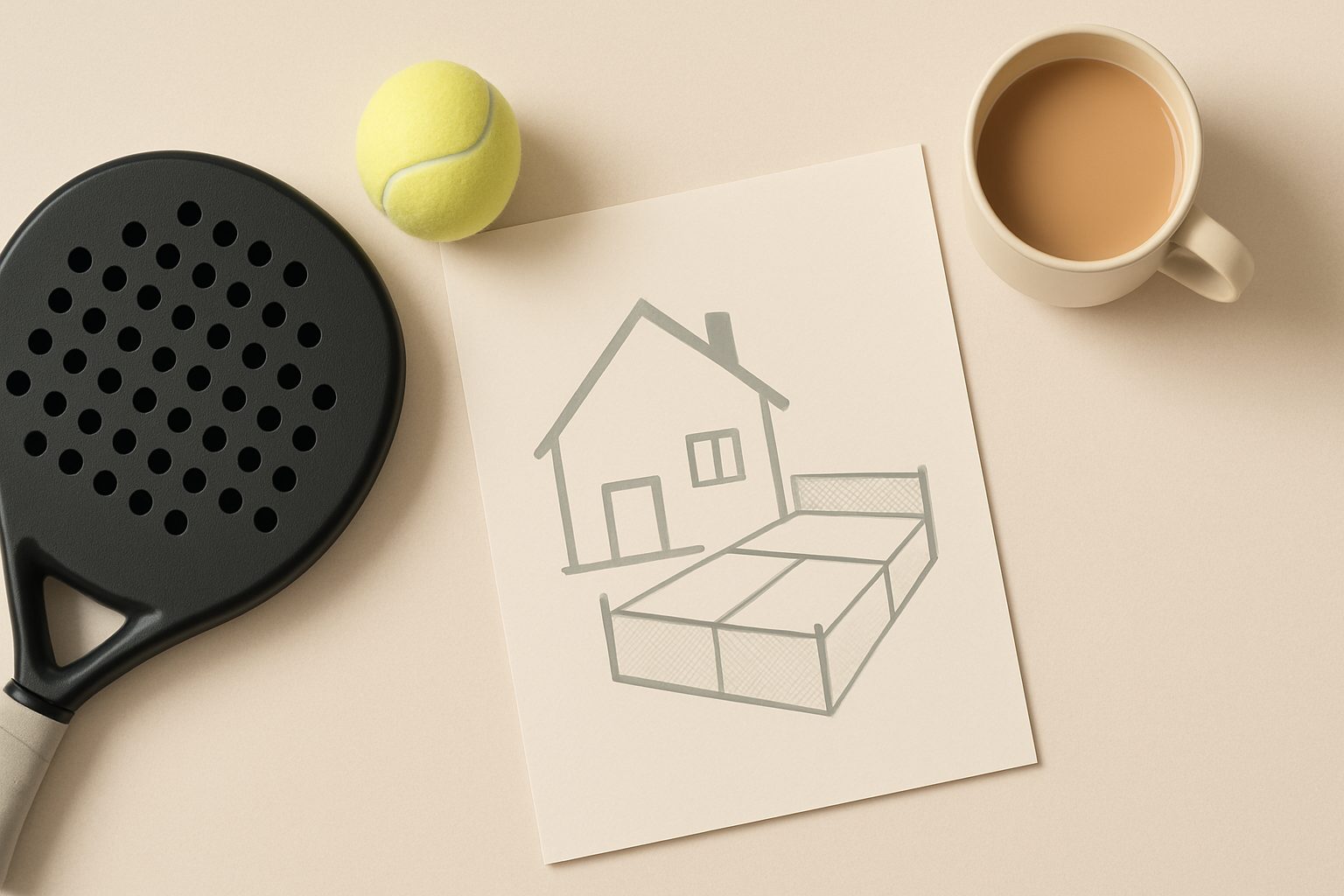
Garden Padel Court vs Tennis Court: Which Is Better for UK Homes?
If you've got space in your garden and want to install a court, you're probably weighing padel against tennis. Both are excellent options, but they're quite different beasts—and for most UK homeowners, one will genuinely suit you better than the other.
The Space Reality
This is where the decision often ends for many people. A tennis court needs about 260 square metres—roughly the size of five or six generous gardens. You're looking at 23m × 11m, minimum, to play properly.
A padel court is roughly half that size. You need around 200 square metres for a proper setup, but it's measured as 20m × 10m. That's still significant, but it fits into larger gardens where a tennis court simply wouldn't. If you've got what you'd call a "substantial" garden—not massive, just genuinely spacious—padel becomes viable where tennis isn't.
The other reason space matters: planning permission. Tennis courts are more visible, take up more visual bulk, and local authorities scrutinise them harder. Padel courts, being enclosed with high walls, can sometimes look less obtrusive and occasionally face less resistance in the planning process. That said, neither is guaranteed—it depends entirely on your council and your location.
The Cost Comparison
A basic padel court kit runs £8,000–£15,000 for materials and installation, depending on whether you're building on artificial grass or concrete, and what spec walls you choose. A proper tennis court starts around £15,000 and easily reaches £25,000–£35,000 once you've factored in professional installation, proper base layers, and line marking.
Maintenance costs differ too. Tennis courts need regular resurfacing (every 5–7 years), which costs £3,000–£5,000. Padel courts need less intensive maintenance—occasional wall repairs and artificial grass replacement—but they're not free. Budget £300–£500 annually for both.
Learning and Playability
This is honest ground: more UK players know how to play tennis than padel. If you've got teenagers or friends who play tennis, they can step onto your court immediately. Padel has a gentler learning curve—the walls mean fewer lost balls, play is faster-paced and less physically demanding—but you'll need people who actually want to learn or already play.
For families, padel is often better. It's easier for beginners, less exhausting than tennis, and the walls mean even weaker shots stay in play. For serious players or those already embedded in tennis clubs, a tennis court might offer more immediate social utility.
Resale Value Impact
Be realistic here. Neither a tennis court nor a padel court significantly increases your property value. What they do is appeal to a niche buyer—someone actively looking for a sports-focused home. In the right location (affluent areas, near padel-playing communities), a well-maintained court might add 2–5% to perceived value. In most places, you'll get your money back in terms of buyer interest, but not a premium.
The advantage to padel: it's newer, trendier, and generates more curiosity. A tennis court is expected; a padel court is interesting. For resale in South East England or areas with established padel communities (London, Surrey, Cheshire), this matters.
The Planning Permission Factor
This is critical. Planning permission isn't automatic for either. Your local authority will care about:
- Height (padel walls are typically 3m–4m, which often requires permission; tennis courts are lower profile)
- Visual impact and screened views
- Whether you're in a conservation area or green belt (much stricter)
- Drainage and ground stability
- Neighbour objections
Get preliminary advice from your local authority before spending money on designs. Many councils have pre-application consultation services—worth using.
Which Should You Choose?
Choose padel if:
- Your garden is 200+ square metres but less than 260
- You want lower ongoing maintenance and less intensity of play
- You're in an area with growing padel interest (most urban areas now have clubs)
- You want something that feels more "current" for resale interest
- You've got beginners or mixed-ability players in your life
Choose tennis if:
- Your garden is genuinely large (260+ square metres)
- You already play tennis seriously or have a tight group of players
- You live in an area where everyone plays tennis (some rural and commuter-belt regions)
- You prefer the simplicity of a proven, familiar sport
- Resale isn't a concern and you're building for yourself
Getting Started: Kits and Rackets
If you're genuinely on the fence, start small. A padel court kit—which includes walls, netting, and basic flooring—makes sense because you can trial it before committing fully. Buy a starter bundle of padel rackets (£50–£100 for a decent set of four) and see if the sport actually grabs you and your household.
For tennis, you've got more flexibility in courts already built nearby—trial it at a club first rather than committing to a home court.
The honest answer: padel is better for most UK homes. It asks for less space, costs less, and honestly, the play is more accessible. But if you've got the space and a serious tennis community around you, a tennis court is the more established choice. Either way, get professional input and check with your local planning authority before you commit.
More options
- Padel Rackets & Starter Bundles (Amazon UK)
- Padel Balls (ITF & FIP Approved) (Amazon UK)
- LED Sports Floodlights for Padel Courts (Amazon UK)
- Padel Ball Machines (Amazon UK)
- Padel-Spec Artificial Grass & Sand Infill (Amazon UK)