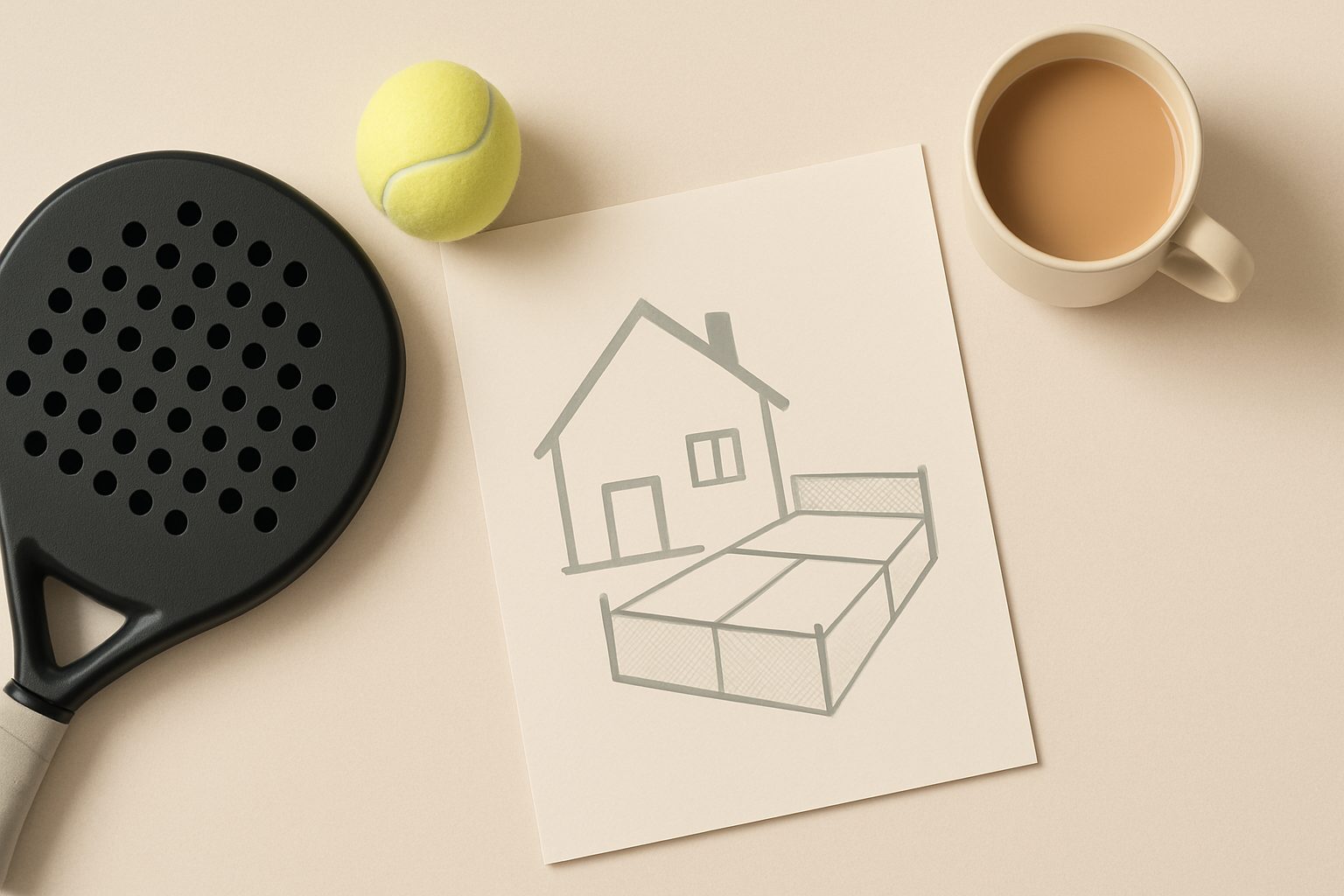
Mini & Compact Padel Courts for Small UK Gardens: What's Possible?
Padel has exploded in popularity across the UK, but if you've got a modest garden, a regulation 20m × 10m court seems about as realistic as fitting a full tennis court behind your shed. The good news? You've got realistic options that don't require a lottery win or half your garden. The less good news? You'll need to compromise somewhere, and understanding those trade-offs matters before you commit cash and space.
The Reality of Garden Space
A standard padel court is 20 metres long and 10 metres wide—roughly the size of two tennis courts side-by-side. Most UK gardens, even generous ones, aren't that spacious. A 30m × 20m plot is genuinely large for residential property, and that's only just enough for a regulation court with minimal surrounding clearance.
The real question isn't "can I fit a mini padel court in my garden?" but rather "what compromises am I willing to make, and will it still be playable?"
Compact Court Dimensions That Actually Work
Several manufacturers now offer sub-standard dimensions marketed as "compact" or "mini" courts. Here's what's genuinely available:
The 16m × 8m option is the most common compromise. You lose 2 metres lengthways and 1 metre widthwise. For recreational play, this is workable—you'll notice it in speed of play and ball trajectory near the back wall, but casual matches and training drills adapt reasonably well. Fits into a 25m × 15m space with modest buffer.
The 18m × 9m court sits between full-size and compact. It's closer to regulation feel and fewer players complain about the confined space. You'll need roughly a 28m × 18m property minimum.
Portable half-courts (10m × 10m) are marketed by several suppliers. These are genuinely portable and suit practice and coaching scenarios, but you're not playing a proper match. Useful if you're a coach or serious player doing solo drills, less so if you want recreational play with friends.
What Actually Limits You in Small Spaces
Before you measure your garden, understand the real constraints:
Setback from boundaries. Planning regulations often require distance from neighbours' fences—typically 1–2 metres. That's not negotiable if you want a solid installation. A court in the middle of your garden is one thing; a court six inches from your neighbour's fence will cause genuine friction.
Underground considerations. Padel courts need decent drainage, and you'll need to check for services—water pipes, gas, electrics, drainage runs. A compact court still requires substantial groundwork. Budget for a proper survey.
Wind and noise. A glass-backed court amplifies both. If your garden's exposed or you're close to neighbours, the £3,000–£5,000 saving on a compact build might vanish when you're buying sound barriers and planning disputes ensue.
Ball escape. Smaller courts mean the ball hits side netting faster, harder, and at sharper angles. You'll lose more balls into neighbours' gardens unless you're running a genuinely tight setup.
Portable and Modular Options
If permanent installation feels like overkill, several UK suppliers now offer modular court kits and portable nets. These aren't joke setups—they're engineered, serious kits, not garden party novelties.
Portable perimeter netting systems (typically 4–5 metres on a side) work for coaching and solo practice. Brands like Padel Court UK and Court Systems UK sell kits that install in days and cost £2,000–£4,000. They won't give you a full match experience, but they're genuinely playable for drills and technique work.
Collapsible frame courts (often 10m × 5m or 12m × 6m) are available through specialist retailers. These sit somewhere between a training net and a permanent court—more structured than a net, less intrusive than a build. Installation is typically a weekend job.
The Installation Reality
Don't underestimate labour and foundation costs. A compact 16m × 8m court still requires:
- Site survey and groundwork (£1,500–£3,000)
- Concrete or macadam base (£3,000–£6,000)
- Court build and netting (£8,000–£15,000)
- Lighting, if you want evening play (£3,000–£7,000)
Permanent installation assumes planning approval. Some councils treat a compact court as a temporary structure; others don't. Check with your local authority before committing money.
Honest Assessment: Will It Work for You?
A mini padel court works brilliantly if you're using it for:
- Regular coaching or lesson delivery
- Solo or partner drill practice
- Fitness training
- Occasional recreational play with one or two regular partners
It's less ideal if you want:
- Competitive or tournament-standard play
- Regular multi-pair matches
- That "proper court" feel without compromise
Practical Next Steps
If you've got a 25m × 18m garden minimum, you've realistic options. Measure carefully—include setbacks from boundaries. Contact suppliers like Court Systems UK, Padel Court Installations, or Padel Pro for site-specific quotes. Several now offer 3D renders so you can see what your garden actually looks like with a court installed.
For tighter spaces, portable netting systems are your sweet spot. They deliver genuine playability without permanent commitment, and you can upgrade later if padel truly becomes part of your routine.
The honest truth: there's no magic solution that gives you full-size play in a compact garden. But there's plenty of middle ground that makes regular padel genuinely possible at home, as long as you're clear on your own expectations.
More options
- Padel Rackets & Starter Bundles (Amazon UK)
- Padel Balls (ITF & FIP Approved) (Amazon UK)
- LED Sports Floodlights for Padel Courts (Amazon UK)
- Padel Ball Machines (Amazon UK)
- Padel-Spec Artificial Grass & Sand Infill (Amazon UK)