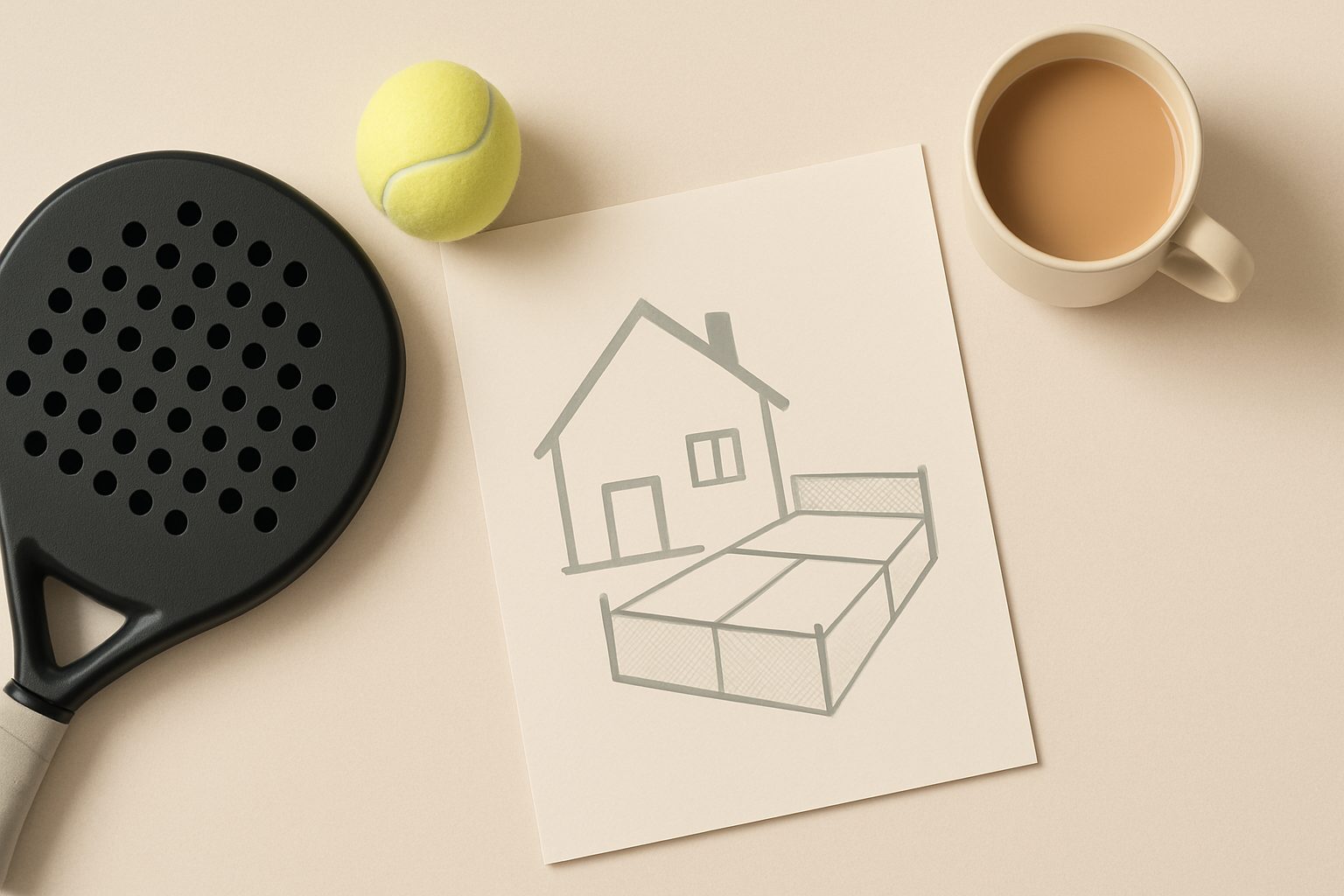
Adding a Padel Court to Your Residential Property UK: Costs, ROI & Planning Tips
Installing a padel court at home is no longer the preserve of wealthy estates with acres to spare. Modern modular courts fit suburban gardens, and the sport's explosive UK growth has made residential installations genuinely viable. But the investment is substantial, planning permission is unpredictable, and ROI depends heavily on your property's size, location, and how seriously you'll use it.
Capital Costs: What You'll Actually Spend
A basic outdoor padel court runs £25,000–£40,000 for materials and installation. This covers a regulation 200m² court (20m × 10m) with the essential glass and metal-mesh perimeter, decent lighting, and a stable base. Premium builds—with superior glass, heating, weatherproofing, or indoor variants—push well beyond £60,000.
These figures are realistic because padel courts require precision engineering. The playing surface must be completely level, the perimeter enclosure needs to withstand repeated ball impact without degradation, and lighting has to be adequate for safe evening play. Corners aren't easily cut without compromising usability.
Your specific costs depend on:
- Ground preparation: If your garden slopes or has poor drainage, expect £3,000–£8,000 for levelling and foundation work
- Access and installation logistics: Tight urban gardens or listed-building contexts add complexity and cost
- Lighting: Basic LED floodlighting costs £4,000–£7,000; anything less leaves you playing in shadow
- Fencing and screening: Neighbours might object to a large glass box; additional acoustic screening adds £2,000–£5,000
Get at least three quotes from established installers. The market is growing but still relatively niche, so rates vary considerably by region.
Property Value and Resale Impact
Property value uplift from a padel court is real but modest—and not guaranteed. Surveys of UK residential sales suggest a court might add 2–5% to a property's value if the property already has significant acreage and sits in a desirable area. In suburban or urban settings, the uplift is closer to 1–2%, sometimes offset by concerns about noise, maintenance obligations, or aesthetic impact.
The honest picture: a padel court appeals to a narrow buyer demographic. If you're selling in five years, a buyer interested in padel courts will pay more. A buyer indifferent to the sport may simply see a large permanent structure that takes up garden space. You won't recoup the full installation cost through property appreciation alone.
The strongest value case exists in affluent postcodes where leisure amenities are expected—Surrey villages, Cotswolds edges, wealthy suburbs of London, Manchester, or Edinburgh. In these contexts, a well-maintained court reads as a luxury addition. In more modest areas, the uplift is marginal.
Rental Income and Active Use
Where padel courts begin to make financial sense is active use and income generation. A properly marketed court can hire out at £40–£80 per hour for casual play, or £100–£150 for tournament-standard weekend bookings. If you rent out 4–5 hours per week at average rates, you're generating £800–£1,500 monthly gross income—which approaches £10,000–£18,000 annually.
That's tempting, but realistic constraints matter:
- Liability and insurance: Commercial hire requires specific sports liability insurance, typically £1,500–£3,000 annually. Many standard homeowner policies exclude commercial use entirely
- Time and maintenance: Courts need regular cleaning, line repainting, glass maintenance, and lighting checks. Budget £2,000–£4,000 annually for upkeep, plus your own time
- Planning permission complexities: Operating a court for commercial hire often requires formal permission or a change-of-use assessment, which local authorities scrutinise closely
- Neighbour relations: Regular players and hire bookings mean traffic, noise, and activity your neighbours will notice
Rental income works best if you're genuinely enthusiastic about the sport, have space for parking and spectator seating, and your local authority is sympathetic to sports amenities. It's not a passive income stream.
Planning Permission and Legal Hurdles
This is where many residential padel projects stall. Courts are treated as structures, and rules vary sharply by council.
In green-belt areas, you'll likely need formal planning permission, which is rarely granted unless the court is ancillary to an existing residential complex or a genuine sports club. Outside green-belt, permitted development often allows structures under certain size and setback thresholds—but "often" isn't "always," and your council's interpretation matters.
Before committing funds, contact your local authority's planning department with dimensions and intended use. A 30-minute conversation now beats a £40,000 installation and a stop-notice later.
Additional legal checks:
- Listed buildings or conservation areas: Extra restrictions almost certainly apply
- Covenants: Some residential deeds restrict permanent structures
- Building regulations: Courts need sign-off if they exceed certain specifications
- Neighbour consultation: Technically optional, but disputes over noise or visual impact cause friction
Insurance and Liability
Standard home insurance won't cover a padel court. You'll need specialist sports-liability insurance if anyone plays there (beyond immediate family), which insurers typically require if you're seeking any income.
Expect premiums of £1,500–£3,000 annually for modest recreational use, rising sharply if you're hiring out commercially. Some insurers won't touch residential courts at all.
Is It Worth It?
A padel court is worth installing if you play regularly, have space to accommodate it without friction, can navigate planning approval, and view it as a lifestyle amenity rather than an investment recovery. The combination of capital cost, maintenance, and modest resale uplift means you won't break even purely on property appreciation.
If renting out appeals, the rental income case is stronger—but only if planning permission allows commercial use and you're willing to operate it professionally. For pure personal use, install one because you love padel, not because you expect to profit.
More options
- Padel Rackets & Starter Bundles (Amazon UK)
- Padel Balls (ITF & FIP Approved) (Amazon UK)
- LED Sports Floodlights for Padel Courts (Amazon UK)
- Padel Ball Machines (Amazon UK)
- Padel-Spec Artificial Grass & Sand Infill (Amazon UK)